Colour Assessment Cabinet

Colour Assessment Cabinet

Colour Assessment Cabinet Specification

  • Humidity
  • Ambient
  • Max Height
  • Approx. 70-75 cm
  • Power Supply
  • 230V AC, 50Hz
  • Interface Type
  • Manual / Switches
  • Number of Specimens
  • Multiple at a Time
  • Application
  • Visual assessment of colour under different light sources
  • Equipment Type
  • Colour Assessment Cabinet
  • Test Range
  • Visual Assessment Only
  • Display Type
  • Indicator Lights for Source Selection
  • Specimen Size
  • Customizable / Various Sizes
  • Frequency
  • 50 Hz
  • Response Time
  • Instantaneous Switching
  • Accuracy
  • Human Visual Inspection (No Instrumental Precision)
  • Temperature
  • Variable, Room Ambient
  • Features
  • Multiple light sources, robust construction, easy operation
  • Mounting Type
  • Tabletop
  • Operating Voltage
  • 230V AC
  • Automation Grade
  • Manual
  • Usage
  • Colour Matching, Shade Comparison
  • Machine Weight
  • Approx. 25-35 Kg
  • Control Mode
  • Manual Switch/Push Buttons
 

Colour Assessment Cabinet Trade Information

  • Main Export Market(s)
  • Asia
 

About Colour Assessment Cabinet

As a Authorized dealer we are engaged in providing the broad assortment of wide gamut of optical instruments for Optical Instruments
Colour assessment cabinets are suitable for any industry where there is a need to maintain colour consistency and quality.

These include paint, textiles, automotive, ceramics, cosmetics, dyeing, food, footwear, inks, knitwear, packaging, printing, etc.

The Elcometer 6300 range of colour assessment cabinets, also known as light cabinets or colour matching booths, ensures accurate visual colour assessment and colour comparison. Constructed from steel, Elcometer's lightweight colour assessment cabinets are supplied with different light sources used to simulate different conditions.

Light sources available:

 Artificial Daylight (D65)

  • Point of Sale Illuminant (TL84 supplied with UK 240V/EUR 220V models, CWF supplied with US 110V models)
  • Home Illuminant (Illuminant A)
  • Ultraviolet Illuminant (UV)
  • Alternative Point of Sale Illuminant (TL83 emits a reddish, yellow energy)


The Elcometer 6300 Colour Assessment Cabinets also enable easy detection of metamerism. Metamerism is commonly discussed in the terms of illuminants, where two samples appear the same (spectrally matched) under one illuminant, but not another. For example, two car door panels appear the same colour in daylight, but, under a streetlight at night, appear as completely different colours.

There is a choice of 3, 4 or 5 light sources with the Elcometer 6300 range. Cabinets are either available with manual light source selection or digital light source selection. The digital cabinets are able to programme the sequence of lights and the duration of each illumination. The lamp timer function, which is standard on all digital cabinets and as an option on manual cabinets, measures the number of hours the D65 daylight bulb has been in operation.

 The Elcometer 6300 range is available with a choice of 3, 4 or 5 light source cabinets, in a range of sizes and functionality to suit your particular requirements. Lamp Kits are available for each Colour Assessment Cabinet.
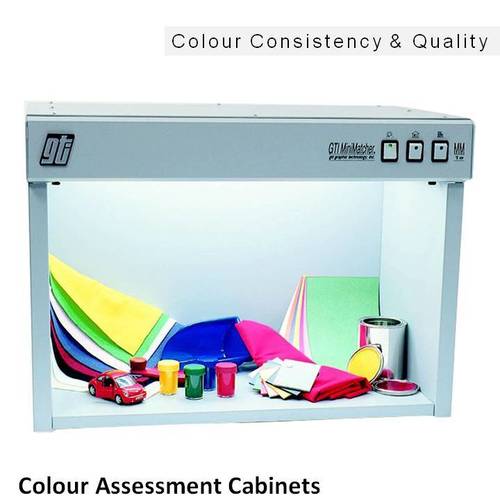


Advanced Multi-Source Colour Assessment

The Colour Assessment Cabinet features up to five standard light sources, including D65, TL84, and more, allowing users to evaluate colours under different lighting conditions. Its robust construction and matte neutral grey interior ensure reliable results, while customizable specimen capacity enhances usability across industries.


User-Friendly Design and Operation

Equipped with individual switches and digital hour meters for each source, the cabinet offers intuitive manual controls. Indicator lights facilitate quick source selection, and silent operation contributes to user comfort. The large viewing area accommodates multiple specimens, supporting efficient workflow during shade matching and comparison.


Quality and Versatility for Professional Applications

Suitable for various environments such as laboratories, manufacturing units, and trading establishments, this cabinet is ideal for distributors, exporters, importers, suppliers, and wholesalers. Its flexibility in specimen size and lighting configuration ensures every colour assessment meets professional standards.

FAQs of Colour Assessment Cabinet:


Q: How does the Colour Assessment Cabinet facilitate accurate colour matching?

A: The cabinet provides up to five different standardized light sources (D65, TL84, UV, CWF, Incandescent, U30) within a matte neutral grey viewing chamber, reducing colour distortion. This allows users to visually assess colour and shade consistency under a range of lighting conditions, ensuring reliable matching.

Q: What specimens can be evaluated using this cabinet?

A: The cabinet supports multiple specimens at a time, with customizable capacity based on user needs. Specimen size is flexible, accommodating various samples ranging from textiles to packaging, as long as they fit the approximately 60 cm x 50 cm x 40 cm viewing area.

Q: When should the lamps be changed or maintained in the cabinet?

A: Each light source is equipped with a digital hour meter and lamp change indicator. Regular monitoring of these meters and indicators will help users schedule timely maintenance to preserve consistent illumination quality during visual assessments.

Q: Where is this equipment best used?

A: This Colour Assessment Cabinet is ideal for use in quality control labs, production units, trading offices, and research environments. Its versatile table-top design makes it suitable for both centralized and decentralized workstations in the colour inspection workflow.

Q: What is the process for switching between different light sources?

A: The cabinet utilizes individual manual switches or push buttons for each light source, allowing the user to instantly select or change lighting conditions. Indicator lights confirm the activation of each source, streamlining the visual assessment process.

Q: How is silent operation beneficial during assessments?

A: Silent operation ensures that external noise does not interfere with the inspectors concentration, fostering a focused environment for careful colour evaluation and minimizing distractions that could affect visual judgments.

Q: What are the main benefits of using the Colour Assessment Cabinet?

A: Key benefits include accurate visual comparison under multiple lighting conditions, robust and durable construction, easy-to-use manual controls, customizable specimen accommodation, and instant switching between light sourcesall enhancing efficiency for colour matching and shade comparison tasks.

Tell us about your requirement
product

Price:

Quantity
Select Unit

  • 50
  • 100
  • 200
  • 250
  • 500
  • 1000+
Additional detail
Mobile number

Email

More Products in Optical Instrument Category

Paper Gloss Meter

Paper Gloss Meter

Application : Measurement of gloss on paper and board surfaces

Power Supply : 220V AC, 50 Hz

Number of Specimens : Single Specimen

Control Mode : Manual

Measuring Range : 0 199.9 GU

Display Type : Digital LED

Reflectance meter

Reflectance meter

Application : Measurement of reflectivity of surfaces, textiles, papers, or paints

Power Supply : 230V AC, 50 Hz

Number of Specimens : Single specimen at a time

Control Mode : Manual

Measuring Range : 0100%

Display Type : Digital LCD display

Sphere Spectrophotometer

Sphere Spectrophotometer

Application : Color measurement, quality control, laboratory analysis

Power Supply : Rechargeable lithium battery, DC5V/2A USB charger

Number of Specimens : 1 at a time

Control Mode : Button and Touch Controls

Measuring Range : Reflectance: 0200%

Display Type : Color touchscreen

Iron-cobalt Color Comparison Tester

Iron-cobalt Color Comparison Tester

Application : Determination of color concentration in ironcobalt analytical solutions

Power Supply : Not Required (Manual)

Number of Specimens : 6 test tubes per set

Control Mode : Manual

Measuring Range : Color intensity comparison

Display Type : Visual/manual comparison


Back to top