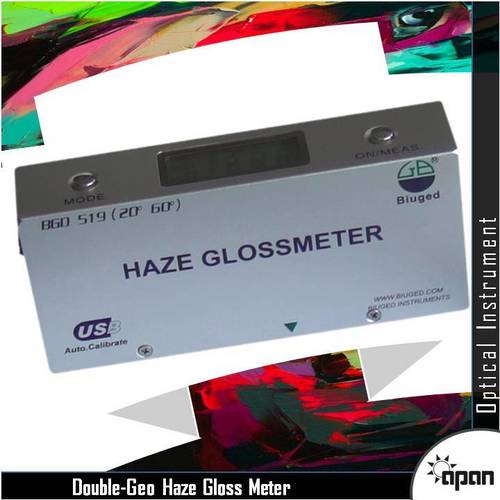
Double-Geo Haze Gloss Meter About
As a Authorized dealer we are engaged in providing the broad assortment of wide gamut of optical instruments. This Intelligent Double-Geo Haze Glossmeter uses both geometries together to calculate the haze on a high-gloss or highly polished surface. Haze is used to describe the situation when two high gloss surfaces have similar gloss values at 60 angel, but one of the surface has a milky/hazy appearance compared to the other.
Poor product formulation or polishing effects leading to a drop in surface quality can quickly be identified using the Double-Geo Haze Glossmeter- Calculates haze to ASTM D 4039
- Measures using the 60 geometry
- Measures using the 20 geometry
- Haze measurement Modefor BGD 519/2
- Calibrate automatically.
- Statistical analysis for 10 group data
- USB Connection
Main Technical Parameters- Reading Range0.099.9GU200.099.9GU20
- 1002000GU201001000GU20
- Data repeatability0.2GU0~99.9GU0.2%100~1999GU
- Data quantitative repeatability0.5GU0~99.9GU0.5%100~1999GU
- Windows Size1152mm
- The size of measuring aperture1010mm201020mm60
- Confirm StandardASTM D 4039ISO 2813ASTM D523
- Dimensions144mmL64mmH 32mmD
The Double-Geo Haze Gloss Meter allows users to measure surface gloss at both 20 and 60 angles, as well as haze up to 30%. This dual functionality helps professionals assess the visual and optical properties of surfaces, ensuring quality across coatings, plastics, and glass products.
User-Friendly Calibration and Spacious Data StorageCalibrating the device is simple with the included standard calibration plate, guaranteeing consistent accuracy. The gloss meter can store up to 1000 readings, enabling users to manage extensive datasets for quality control, record keeping, or analysis without frequent data transfers.
Portable, Efficient, and CompliantWeighing approximately 1.2 kg and powered by four AA batteries, the meter is lightweight and portable, suitable for on-site and laboratory settings. It complies with major standards like ASTM D523 and ISO 2813, and provides results in less than 2 seconds, combining efficiency with trusted performance.
FAQs of Double-Geo Haze Gloss Meter:
Q: How do I calibrate the Double-Geo Haze Gloss Meter before starting measurements?
A: Calibration is straightforward using the standard calibration plate included with the device. Simply follow the instructions in the user manual to ensure the gloss meter is set to deliver accurate readings every time you use it.
Q: What surfaces and sample sizes can the meter evaluate for gloss and haze?
A: The meter is suitable for measuring gloss and haze on coatings, plastics, and glass. It accommodates samples with a minimum size of 60 mm x 40 mm and thicknesses up to 10 mm, making it versatile for various industrial applications.
Q: When should I use the 20 versus the 60 geometry angle setting?
A: Use the 20 geometry for highly glossy surfaces and the 60 setting for medium to low gloss areas. This dual-geometry approach provides accurate measurement across a broad range of surface gloss levels, following ASTM D523 and ISO 2813 standards.
Q: Where can I store or transfer my measurement data from the gloss meter?
A: The device holds up to 1000 readings, which can be reviewed on its digital LCD. For further analysis or reporting, simply transfer your data to a computer using the built-in USB interface.
Q: What is the process for taking continuous versus single measurements?
A: Single measurement mode captures one reading per action, ideal for spot checks. Continuous mode collects multiple sequential results quickly, suitable for scanning larger surfaces or obtaining more comprehensive gloss and haze profiles.
Q: How can the gloss meter benefit quality control in manufacturing or exporting?
A: Accurate gloss and haze measurement ensures product consistency and compliance with industry standards, reducing the risk of quality-related returns or complaints during distribution, export, or supply operations.

 Send Inquiry



 Send Inquiry

 Send Inquiry


