About Rebound Hammer
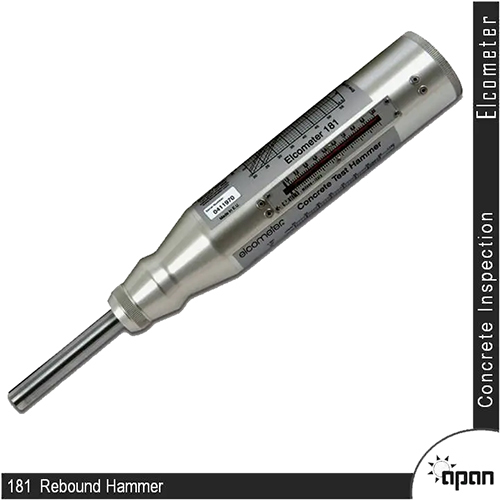
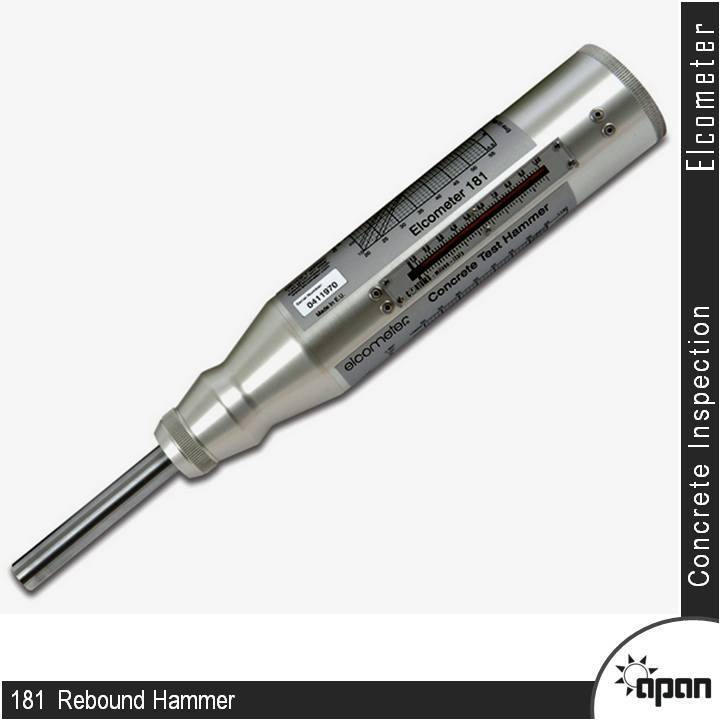
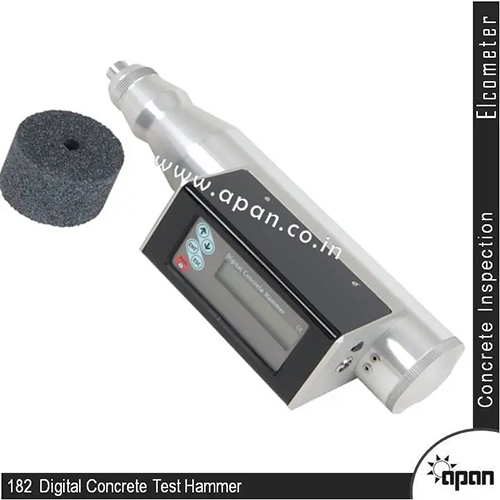
As a Authorized dealer we are engaged in providing the broad assortment of Elcometer, UK make 'Concrete Inspection' Equipments. Elcometer 181 Analogue Concrete Test Hammer provides a quick, simple and inexpensive method for non-destructive evaluation of concrete compression strength and other masonry materials.
Concrete test hammers are one of the most widely used instruments in the field of non-destructive testing and Elcometer offer both mechanical and digital models.
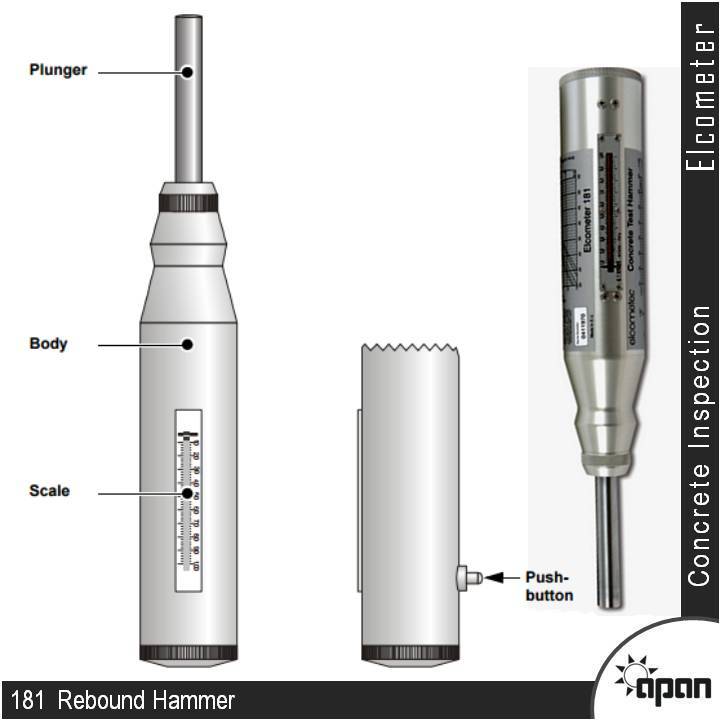
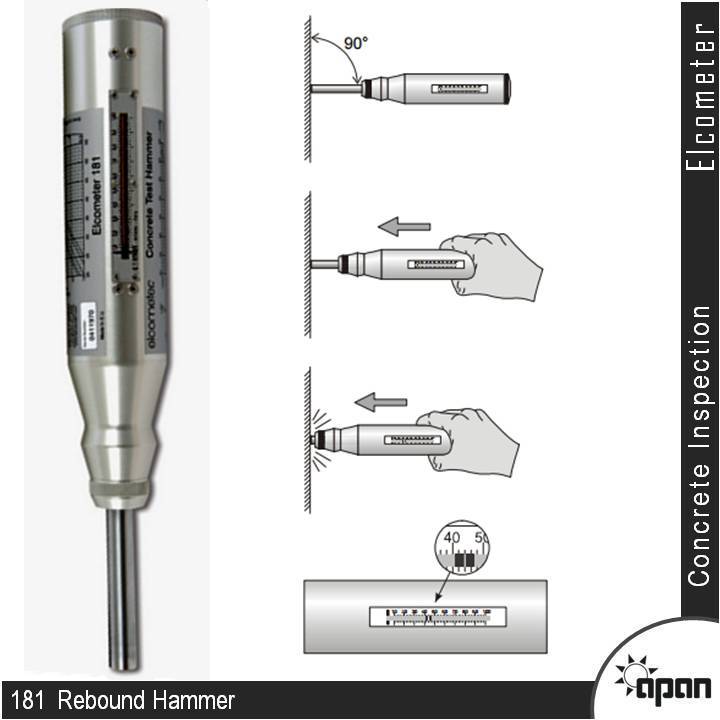
This gauge consists of a spring loaded plunger which, when released, strikes the surface with fixed and constant impact energy. During the rebound stroke, the mass moves a pointer that indicates the maximum point of return and at the same time indicates a reference value called Rebound Number.
This number, converted by the correlations available on the hammer, gives the compression resistance value in respect of the impact angle.
Key Features:
- Impact Energy 2.207 Nm
- Supplied with grinding stone to prepare test surface
- Aluminium body
- Rebound value indicated on test hammer
- Rebound value chart on body, for quick calculation of compressive strength
- Curve selection on chart dependant on testing angle
Specification
Accuracy | Better than +/- 2 Rebound Number (When tested on Calibration Anvil at 80) |
Resolution | 2 Rebound Number(s) |
Range | 10 to 100 Rebound Number(s) |
Dimensions | Hammer: 280mm (11.02") length x 55mm (2.17") diameter In Case: 350mm (13.78") length x 80mm (3.15") diameter |
Weight | 1.5kg (3.3lbs) with case |
Packing List | Elcometer 181 analogue concrete test hammer,
plastic storage case,
abrasive stone
operating instructions |
Efficient and Reliable Concrete TestingDesigned specifically for concrete surface hardness assessment, the rebound hammer provides instant readings, facilitating quick decision-making on construction sites. Its robust, corrosion-resistant aluminium body ensures longevity and consistent performance even in demanding environments. With manual control and no requirement for power supply, the tool offers simplicity and reliability during everyday usage.
Certified Accuracy and Standards ComplianceEach rebound hammer is supplied with a calibration certificate, ensuring measurement accuracy within 1 N/mm and adherence to recognized international standards. This ensures that testing results are trusted and suitable for both field application and official reporting. Its analog scale display simplifies the process, making interpretation of results both straightforward and reliable.
Portable Design for On-Site and Laboratory UseWeighing only 1.1 kg and packed in a convenient carrying case, this hammer is ideal for traders, suppliers, and inspectors who require portability without compromising functionality. The device operates efficiently within 0C to 40C and 90% RH, making it versatile for various testing conditions, with no external power required.
FAQs of Rebound Hammer:
Q: How do you use the Rebound Hammer for concrete surface hardness testing?
A: To use the rebound hammer, hold the device against the prepared concrete surface and press the plunger until it releases. The rebound value can then be read instantly on the analog scale, providing an estimate of concrete strength without causing damage to the specimen.
Q: What standards does this Rebound Hammer comply with for quality assurance?
A: The hammer meets IS 13311 (Part 2) 1992, ASTM C805, and EN 12504-2 standards, ensuring its reliability and suitability for professional concrete strength evaluation.
Q: When is calibration required for the Rebound Hammer and how is it ensured?
A: Calibration should be performed each time you suspect measurement deviation or after extensive use. The device comes supplied with a calibration certificate, confirming its accuracy at the time of delivery.
Q: Where can the Rebound Hammer be used effectively?
A: This portable device is suitable for both field inspections and laboratory environments, operating efficiently across a temperature range of 0C to 40C and humidity up to 90% RH.
Q: What is the process for interpreting results using the analog scale?
A: After testing, the rebound value appears on a clear, easy-to-read analog scale. These values correspond directly to concrete compressive strength, allowing quick estimation between 1070 MPa with a resolution and accuracy of 1 N/mm.
Q: What are the benefits of using an aluminium alloy body and hardened steel plunger?
A: The aluminium alloy body ensures lightweight portability and resistance to corrosion, while the hardened steel plunger delivers robust, consistent impact for accurate measurements throughout the instruments lifespan.
Q: Is the Rebound Hammer suitable for large and small specimen sizes?
A: The instrument requires a minimum specimen cube size of 150 mm 150 mm 150 mm for accurate testing, accommodating most concrete test samples used in construction and quality assessments.

 Send Inquiry



 Send Inquiry

 Send Inquiry


