About Corrosion Thickness Gauge
As an Authorized dealer we are engaged in providing the broad assortment of "NDT Instrument" for various applications.
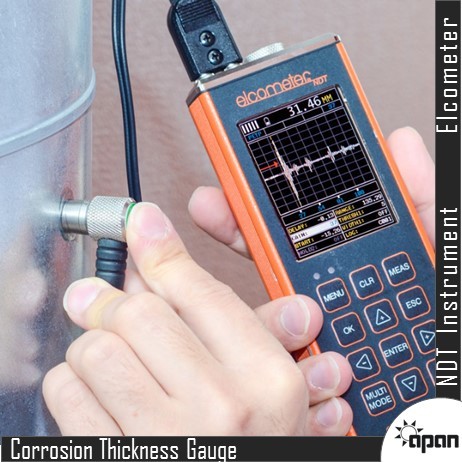
The CG100 series are corrosion gauges that measure with extreme versatility. They have the ability to measure coatings and material thickness simultaneously while maintaining the ability to locate pits, flaws and defects in the material. Based on the same operating principles as SONAR, the CG100 Series have the capability of measuring the thickness of various materials with accuracy as high as +/- 1% or +/- 0.1 millimetres (+/- 0.005 inches) whichever is the greater. The principal advantage of ultrasonic measurement over traditional methods is that ultrasonic measurements can be performed with access to only one side of the material being measured.
The CG100 series also include a data-logging (memory) facility which allows readings to be stored in batches before being downloaded to a computer. Gauge can be used in accordance with the following Standards and test methods; ASTM E 797, EN 14127 and EN 15317.
- Wide range of measurement modes
- Automatic: probe zero, probe recognition, and temperature compensation.
- Adjustable gain settings.
- Stores up to 64 custom setups for specific applications.
- High speed scan mode of up to 50 readings per second.
- Audible/visual alarm with high and low limit settings
- Differential mode for QC inspections.
- RF and RECT A-Scan displays (CG100ABDL gauges only).
- Time based B-Scan display.
- Measurement data storage formats: Alpha numeric grid and sequential. Data can be downloaded to a computer for analysis and storage.
Repeatability / Stability Indicator
- Consisting of 6 vertical bars, when all the bars are fully illuminated and the last digit on the digital thickness value is stable, the gauge is reliably measuring the material thickness.
High Speed Scan with Minimum Thickness Display
- By significantly increasing the measurement refresh rate this mode allows the user to make scanned passes over the test material. The smallest thickness value is held in memory and displayed when scanning is complete. This feature can also be used in conjunction with the minimum & maximum limit alarm feature (model dependant).
Differential Mode
- Once a user defined nominal thickness value has been set, the gauge will display the +/- thickness difference from the nominal value entered.
Limit Alarm Mode
- The user can define minimum and maximum thickness limits. If the measurement falls outside the upper or lower limit a red LED will light and the beeper sounds. A green LED will light to indicate an acceptable thickness.
V-Path Correction
Dual element transducers consist of a probe with two crystals (one to transmit and one to receive the sound pulse). The crystals are separated by an acoustic barrier - generating a 'V-shaped' sound path as the sound travels from one element to the other.
This path is slightly longer than the direct path therefore V-path correction is used to calculate the correct thickness.
Advanced Ultrasonic Measurement TechnologyThis corrosion thickness gauge utilizes a 5 MHz piezoelectric transducer and the ultrasonic pulse-echo principle, enabling accurate, non-destructive testing of material thickness in steel, aluminum, copper, glass, and various homogeneous materials. Its manual operation ensures precise control throughout inspections.
Highly Compatible and VersatileDesigned for extensive applications, this gauge suits a diverse range of solid materials. Whether used in fabrication, maintenance, or process monitoring, its broad test range of 1.2 to 225 mm and no specimen size limitation make it flexible for thickness measurement tasks.
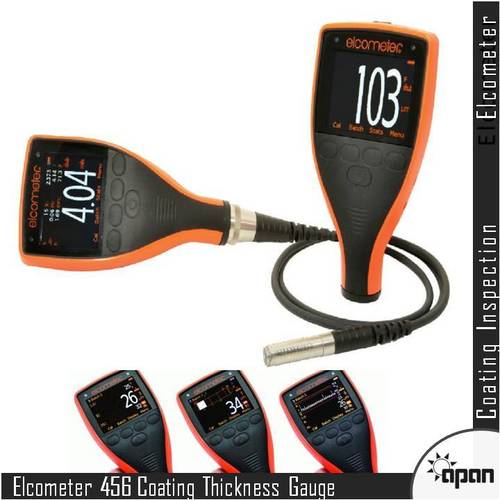
Convenient Design and FeaturesWith a robust ABS plastic casing and an ergonomic handheld design, the gauge boasts an easy-to-read LCD display with backlight and user-friendly controls. Handy features include low battery indication, minimum thickness alarm, data hold, and automatic shutdown, ensuring reliable, uninterrupted operation.
FAQs of Corrosion Thickness Gauge:
Q: How does the corrosion thickness gauge measure material thickness?
A: The gauge uses a piezoelectric transducer and the ultrasonic pulse-echo operating principle. It sends high-frequency sound pulses through the material and measures the time taken for the echo to return, accurately calculating thickness without damaging the specimen.
Q: What types of materials are compatible with this gauge?
A: This device is compatible with steel, aluminum, copper, glass, and other homogeneous solid materials, making it versatile for industrial, maintenance, and quality assurance applications.
Q: When should the minimum thickness alarm function be used?
A: The minimum thickness alarm is particularly useful during corrosion monitoring and regular maintenance inspections, notifying users immediately when the measured material thickness drops below a preset safety threshold.
Q: Where can this corrosion thickness gauge be used?
A: Its broad compatibility and handheld, robust design make it suitable for use in manufacturing plants, construction sites, laboratories, shipyards, and other environments where non-destructive thickness measurements are required.
Q: What is the process for operating the gauge and measuring thickness?
A: Simply turn on the device, calibrate it as needed, and position the probes transducer against the cleaned material surface. The gauge then automatically displays the thickness on the LCD within less than a second using its ultrasonic pulse-echo method.
Q: What are the main benefits of using this gauge for corrosion measurement?
A: Key benefits include rapid and accurate thickness measurement, non-destructive testing, wide material compatibility, extended battery life, portability, and vital safety features such as minimum thickness alarms and data hold functionality.

 Send Inquiry



 Send Inquiry

 Send Inquiry


