Paper Gloss Meter
Paper Gloss Meter
Paper Gloss Meter
Paper Gloss Meter
Paper Gloss Meter
Paper Gloss Meter
Paper Gloss Meter
Paper Gloss Meter
Paper Gloss Meter
Paper Gloss Meter

Paper Gloss Meter

Paper Gloss Meter Specification

  • Humidity
  • 85% RH
  • Resolution
  • 0.1 GU
  • Temperature
  • 10C 40C
  • Features
  • Portable, user-friendly, durable body
  • Test Range
  • 0 199.9 Gloss Units
  • Response Time
  • <2 seconds
  • Specimen Size
  • 60 x 85 mm (Minimum)
  • Mounting Type
  • Bench-top
  • Measuring Range
  • 0 199.9 GU
  • Equipment Type
  • Gloss Meter
  • Display Type
  • Digital LED
  • Automation Grade
  • Manual
  • Port Size
  • Standard port 15x10 mm
  • Operating Voltage
  • 220V AC, 50Hz
  • Number of Specimens
  • Single Specimen
  • Power Supply
  • 220V AC, 50 Hz
  • Accuracy
  • 1.2 GU
  • Application
  • Measurement of gloss on paper and board surfaces
  • Frequency
  • 50 Hz
  • Usage
  • Laboratory & industrial quality control
  • Machine Weight
  • 1.5 kg (approx)
  • Test Speed
  • Standard gloss measurement speed
  • Test Width
  • Up to 60 mm
  • Test Stroke
  • Fixed
  • Control Mode
  • Manual
  • Repeatability
  • 0.5 GU
  • Gloss Angle
  • 75 geometry
  • Construction Material
  • ABS Plastic & aluminum
  • Data Output
  • No data port
  • Light Source
  • LED
  • Calibration
  • Supplied with calibration standard


About Paper Gloss Meter

As an Authorized dealer we are engaged in providing the broad assortment of wide gamut of Colour Appearance test and measurement instruments.

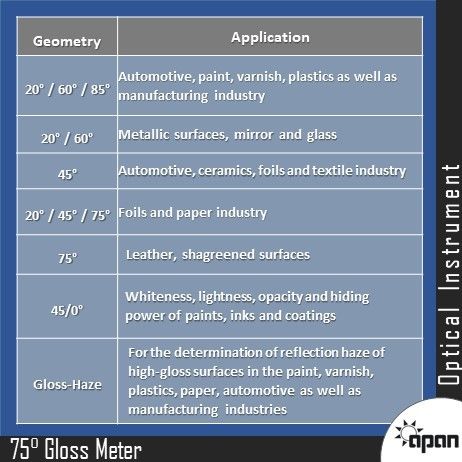
Gloss Meter have different kinds of measurement angles. Generally, 20 used for High Gloss Materials, 60 used for Medium Gloss Materials, 85 used for Low Gloss Materials. Two additional angles are used for other materials. An angle of 45 is specified for the measurement of ceramics, films, textiles and anodised aluminium, whilst 75 is specified for paper and printed materials.

In accordance with international standard ASTMD523, ASTMD1455, ASTMC346, ASTMC584, ASTMD2457, DIN ENISO2813, DIN67530, ENISO7668, JISZ8741, MFT30064, TAPPIT480, GB9754, GB/T13891, GB7706 and GB8807. Its technical parameters conform with JJG696-2002.

  • Accurate measurement, good repetitiveness.
  • Automatic calibration. Small in size, easy to carry.
  • Intelligent design, rapid measurement.
  • Able to store 254 groups of measurements.
  • Uses USB, Bluetooth data output.
  • Built-in lithium ion rechargeable battery.
  • Backlight display, suitable for low light environment.


The 75 degree glossmeter is used primarily for the paper and vinyl producing industries.

For the paper industry several standards for gloss measurement exist, the most common ones are issued by the German DIN (Deutsches Institut Normung) and the American TAPPI (Technical Association of the Pulp and Paper Industry).

The specular gloss of paper and paperboard at 75 degrees (15 from the plane of paper). This method is suitable for low to moderate-gloss coated and uncoated papers as well as for most ink films on paper or paperboard. The standard describes the technical requirements for a corresponding gloss meter.

Display

4 Digits BacklitLCD

Measuring Angle

75

Range

0.1 ~ 200 Gloss Units

Gloss Units

GU

Accuracy

1.0 GU

Resolution

0.1

Repeatability

0.5 GU

Measuring Area

7 x 14 mm (Ellipse

Data Memorized

254 Groups

Operating Conditions

Temp0 ~ 40C

Humidity< 85% RH

Power Supply

3.7 V Lithium Ion Rechargeable Battery

Dimensions

140 x 45 x 75 mm

Weight

305 gIncluding Batteries

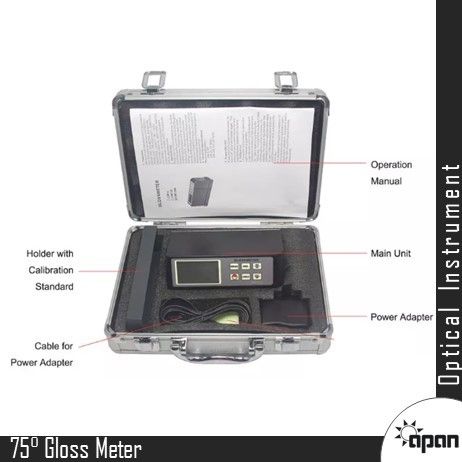
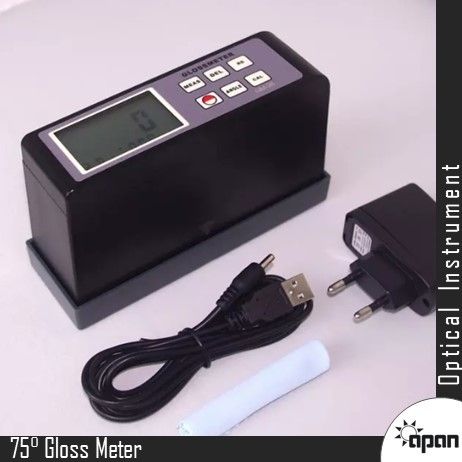
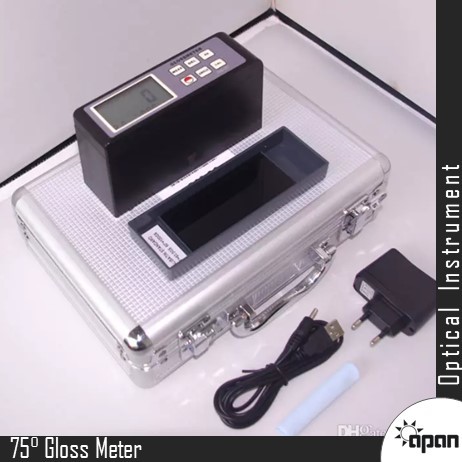
Standard Accessories

Main Unit

Holder with Calibration Standard

AC Adapter

Optical Cleaning Cloth

Carrying Case

Operation Manual

Optional Accessories

USB Data Cable with Software

Bluetooth Data Adapter with Software

ASTM D1223 1998 :Test method for specular gloss of paper and paperboard at 75.

TAPPI T480 OM-90 1990 (USA)  :Specular gloss of paper and paperboard at 75

JIS - Z8142 1993 (Japan) :Testing method for 75 specular gloss
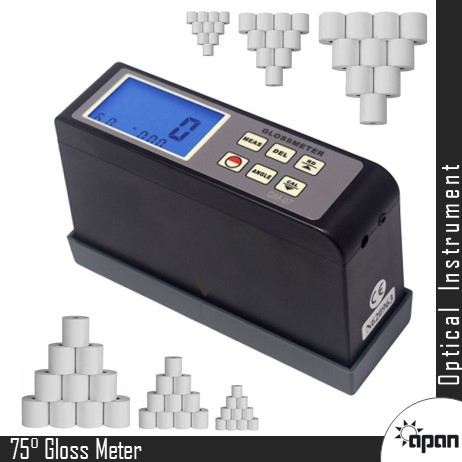


Key Features of the Paper Gloss Meter

Equipped with a digital LED display, the Paper Gloss Meter allows the precise measurement of gloss on paper and board using a standard 75 angle geometry. The stable ABS plastic and aluminum construction ensures reliability and portability. Data is easily readable with fast response time, and the supplied calibration standard maintains measurement accuracy. The device handles single specimens with a test width of up to 60 mm and minimum specimen size of 60 x 85 mm.


Applications and Benefits

This gloss meter serves laboratory and industrial quality control by accurately evaluating surface gloss, a critical factor in packaging, printing, and visual inspection processes. The portable, bench-top design makes it ideal for on-site and routine quality checks. Its efficient calibration and fixed stroke operation streamline inspections, providing dependable results and supporting stakeholders such as distributors, exporters, importers, and traders.

FAQs of Paper Gloss Meter:


Q: How does the Paper Gloss Meter measure surface gloss on paper and board?

A: The Paper Gloss Meter utilizes a 75 geometry and an LED light source to measure the reflection of light on paper and board surfaces. Specimens are placed manually within the standard port, and a fixed test stroke initiates the measurement, with results displayed digitally in gloss units.

Q: What is the calibration process for this gloss meter?

A: Calibration is performed using the supplied calibration standard included with the equipment. This ensures all gloss measurements remain accurate and within the specified repeatability and accuracy range.

Q: When is it recommended to use this Paper Gloss Meter?

A: Use this gloss meter during laboratory or industrial quality control processes, especially when surface gloss is crucial for packaging, printing, or product aesthetics. It is also ideal for routine checks and before final shipment or production approval.

Q: Where can the Paper Gloss Meter be mounted or used?

A: The instrument is designed for bench-top mounting, making it suitable for laboratories and industrial facilities where stable and convenient placement is needed for quality assessment.

Q: What is the benefit of manual control mode in this device?

A: Manual control allows users to closely manage each gloss measurement, facilitating detailed inspection and reducing potential errors during specimen positioning and operation.

Q: How do I operate and read the results from the gloss meter?

A: To operate, insert a specimen into the standard port, initiate the measurement manually, and read the gloss value from the digital LED display. Response time is less than two seconds, enabling quick assessments.

Tell us about your requirement
product

Price:

Quantity
Select Unit

  • 50
  • 100
  • 200
  • 250
  • 500
  • 1000+
Additional detail
Mobile number

Email

More Products in Optical Instrument Category

Gloss Meter for Curve Surface

Gloss Meter for Curve Surface

Test Range : 0200 Gloss Units (GU)

Features : Ergonomic design, Portable, High precision, Data memory

Temperature : 10C to 40C

Machine Weight : 2.5 kg

Humidity : 085% RH

Control Mode : Digital / Manual

Spectrum Transmission Meter

Spectrum Transmission Meter

Test Range : 200 nm 2500 nm

Features : Automatic Zeroing, Simple Operation, Portable Design

Temperature : 5C to 45C

Machine Weight : Approx. 3.5 kg

Humidity : 090% RH

Control Mode : Manual

Visual Colorimeter

Visual Colorimeter

Test Range : 020 units (Lovibond Scale)

Features : Easy sample viewing, color disc for comparison, sturdy construction

Temperature : Ambient 10C40C

Machine Weight : Approx. 7 kg

Humidity : Ambient 10%80%

Control Mode : Manual

Color spectrophotometer

Color spectrophotometer

Test Range : Color reflectance and chromaticity

Features : Portable, High accuracy, Multiple color space data output, Data storage, Calibration function

Temperature : Operating: 0C to 40C

Machine Weight : 2.5 kg

Humidity : Relative humidity less than 85%

Control Mode : Manual Button/Software


Back to top