About Ultrasonic Pulse Velocity Tester
As a Authorized dealer we are engaged in providing the broad assortment of wide gamut of NDT Instruments for Civil Engineering.
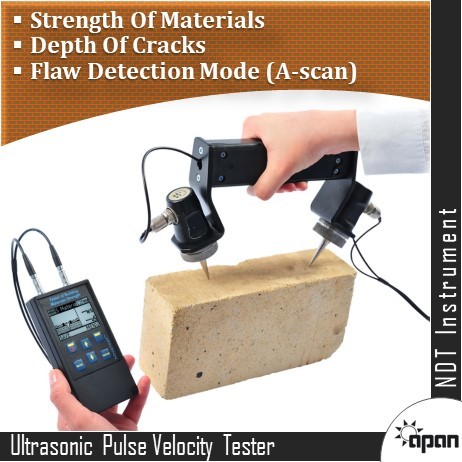
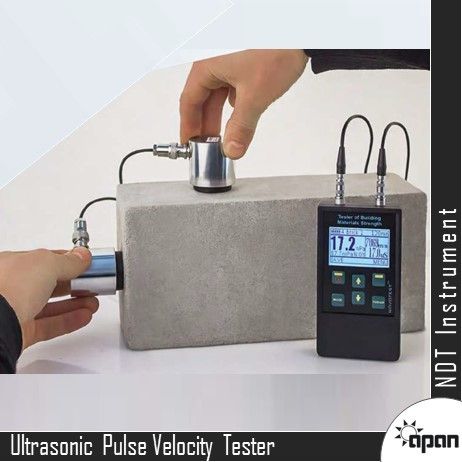
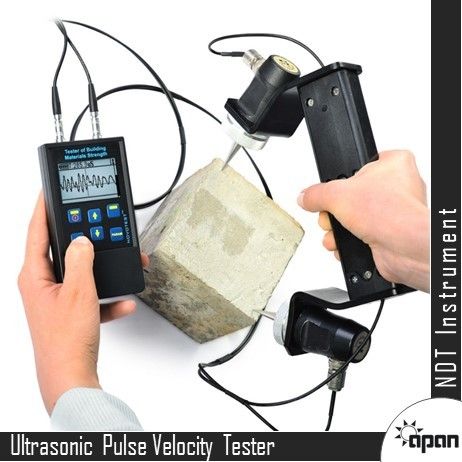
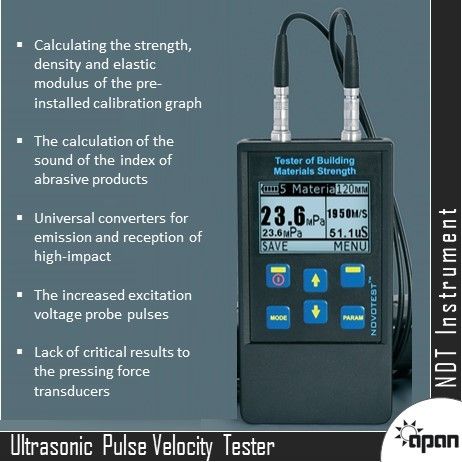
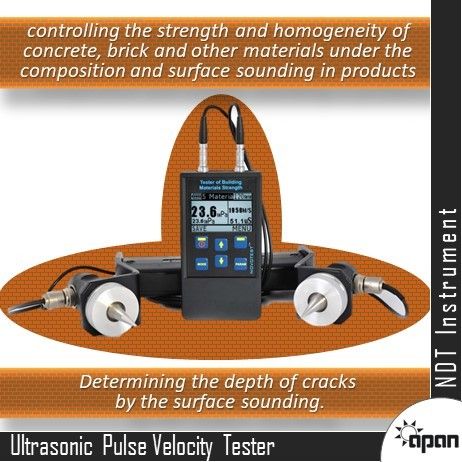
The pulse velocity testerIPSM-U+T+Dallows to measurethe strength and homogeneity of the concrete, bricks and other materials under the composition and surface sounding in products and designs for construction projects, inspection of buildings and structures,according to ASTM C597-16 (Standard Test Method for Pulse Velocity Through Concrete). Has the determining of the depth of cracks by the surface sounding probefunctionand alsoflaw detection mode (A-scan).
Measuring the strength and uniformity of construction materials by ultrasonic method Instrument is designed for:
- detection of voids, cracks and defects encountered in the production and operation of structures (for process control and inspection of facilities);
- control and uniformity of concrete strength (Guidelines MDS 62-2.01), construction and composite materials, structures, bridges and waterworks;
- measure the depth of cracks in the tested materials;
- determine the density and elastic modulus fiberglass and so on;
- definitions of sound index of construction ceramics and abrasives;
- estimates of the porosity, fracturing and anisotropy of the material;
- assess the degree of maturity of the concrete in a monolithic concreting;
- visualize the presence of a signal (A-scan);
- the possibility of test theconcrete (and other) constructions for internal defects, discontinuities;
- improve the accuracy of measurement of time intervals by allowing manual selection of the moment trip meter.
Measurement Options
- OPTION 1 : The simplest modification to measure the strength of materials
- OPTION 2 : Additionally allows control of homogeneity, measure the depth of cracks
- OPTION 3 : The most versatile modification, in which all the functions of previous modifications are implemented, and also flaw detection mode (A-scan) available
Specification
|
The range of measurements of the propagation of ultrasonic vibrations, s
|
10 - 9999
|
|
The measurement resolution of the propagation time of ultrasonic vibration, s
|
0.1
|
|
The operating frequency of the ultrasonic oscillations, kHz
|
50-100
|
|
The base surface sounding measurements in mm
|
120
|
|
The output voltage, V
|
to 600
|
|
Overall dimensions of el. unit, mm
|
122x65x23
|
|
Operating temperature, C
|
-20 +40 C
|
|
Power
|
2 AA batteries
|
|
Time of continuous operation, h, not less
|
10
|
Features
- Calculating the strength, density and elastic modulus of the pre-installed calibration graph
- The calculation of the sound of the index of abrasive products
- Memory of the results
- Communication with PC
- Further processing of the results using a specialized computer program
- Lack of critical results to the pressing force transducers
- Ability to work on large databases with transducers for sounding through-sounding
- Improved ratio of signal-to-noise
- Universal converters for emission and reception of high-impact
- The increased excitation voltage probe pulses
The increased power of the excitation probe pulses, high-quality amplification path can significantly increase the base of sounding and operatingon materials with high damping.
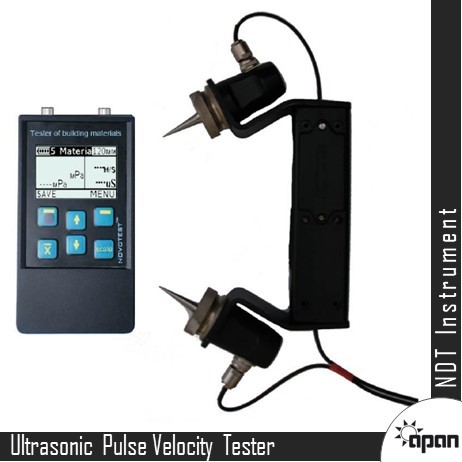
The probe forsurface sounding has a base of 120 mm, suitable for sounding concrete cubes samples.
Precise Assessment for Structural IntegrityDesigned for professional evaluation, the Ultrasonic Pulse Velocity Tester uses pulse-based technology to accurately determine the quality of concrete and other building materials. Its measuring range up to 6 meters and adjustable test speed allow for comprehensive assessment of structural soundness, crack depth, and material uniformitydirectly on site.
User-Friendly Operation and Convenient Data ManagementFeaturing a digital backlit LCD display and an intuitive interface, the tester provides direct read-outs and quick response. Operators can choose between manual or automatic calibration, ensuring precise measurements. The built-in memory stores up to 200 readings, and RS232/USB connectivity makes transferring results to a PC straightforward for further analysis.
Engineered for Versatility and DurabilityProtected by an IP54-rated casing and supplied in a shock-resistant carrying case, the device endures challenging environments. It is suitable for both laboratory and field use across a wide temperature range. Flexibility in mounting and power supply options make it a practical choice for various testing locations.
FAQs of Ultrasonic Pulse Velocity Tester:
Q: How does the Ultrasonic Pulse Velocity Tester help assess concrete quality?
A: The tester measures the time it takes for an ultrasonic pulse to travel through concrete. This data provides insights into the materials density, homogeneity, and the presence of internal flaws such as cracks. The results help engineers assess the quality, strength, and durability of the structure without causing any damage.
Q: What is the process for storing and transferring test results?
A: Results are automatically saved in the devices memory, capable of holding up to 200 readings. Data can be transferred directly to a PC using the built-in RS232 or USB interface, enabling easy management and analysis of test records.
Q: Where can this tester be used and what materials can it evaluate?
A: This tester is designed for use in various settings, including construction sites, laboratories, and factories. It is suitable for non-destructive testing of concrete, natural stone, ceramics, and other building materials to assess structural quality and uniformity.
Q: What are the calibration options available on this tester?
A: The device features both automatic and manual calibration methods. Automatic calibration streamlines routine checks, while manual calibration allows for fine-tuning to meet specific testing requirements and standards such as IS 13311 Part 1 and ASTM C597.
Q: How portable is the Ultrasonic Pulse Velocity Tester?
A: Weighing approximately 2.5 kg and supplied in a shock-resistant carrying case, the tester is highly portable. Its battery operation, wide temperature and humidity tolerance, and rugged design make it suitable for fieldwork and transport to multiple job sites.
Q: When should you use the different control modes?
A: Manual control is ideal for customized, step-by-step tests, while automatic mode expedites repetitive or high-volume testing processes. Choosing between the two allows operators to balance precision and efficiency based on project needs.
Q: What are the benefits of using this tester for building assessments?
A: Using the Ultrasonic Pulse Velocity Tester provides rapid, accurate measurements without damaging the material. This helps in early detection of issues, quality assurance, and compliance with international standards, ultimately leading to safer, more durable constructions.

 Send Inquiry



 Send Inquiry

 Send Inquiry


